
| GJCJ
White 2025

Putting the offender in the spotlight: Identifying common characteristics of non-fatal strangulation perpetrators
Lisa White, University of Gloucestershire1 ([email protected])
Abstract
Objective: Non-fatal strangulation (NFS) within intimate partner violence (IPV) has been previously identified as a predictor to domestic homicide. Though NFS signals escalating violence and lethal danger, it often leaves little visible external injury which has historically provided difficulty prosecuting offenders. Due to its hidden nature and lack of research on offenders, little is known about their characteristics and what motivates them to seriously or fatally abuse.
Method: Secondary data from a 2020 NFS victim survey (n= 469) was analysed using a combination of content analysis and thematic analysis.
Results: Seven common characteristics were identified, creating a profile of a non-fatal strangulation offender; (1) male gendered perpetrator, (2) current or former intimate partner, (3) history of coercive and controlling behaviour, (4) history of abuse, (5) insecure, (6) pleasured by inducing fear, (7) capable of homicide.
Conclusion: Findings contribute to understanding the profile of an NFS perpetrator and assist practitioners and policy makers in recognising the life-threatening and traumatic abuse they inflict on their victims.
Key words
Non-fatal strangulation (NFS), domestic abuse, intimate partner violence (IPV), intimate partner femicide (IPF)
Statement on AI Use
I confirm that I have not used AI tools such as ChatGPT or Large Language Models in the writing of this article, production of images or graphical elements of the paper, or in the collection and analysis of data except in the writing process to improve the readability and language of the manuscript.
Introduction
Coercive Control takes many forms including verbal abuse, intimidation, threats to harm or kill the victim2 and/or their children or family members, isolation from friends or family, monitoring time or location, humiliating their victim, enforcing arbitrary rules, controlling finances, physical intimidation and assault (CPS, 2023; Johnson 2008).
Strangulation is “obstruction of blood vessels and/or airway by external pressure to the neck resulting in decreased oxygen supply to the brain” (White et al., 2021, pp. 1) and can be inflicted by manual pressure applied to the neck; chokeholds or headlocks, ligatures used with an object to tighten it or and hanging (CPS, 2022a). Death by strangulation can be caused with minimal pressure, comparable to opening a can of cola or a man’s handshake, resulting in loss of consciousness within seconds and brain death within minutes (Jordan et al., 2020). Approximately 40% of NFS assaults leave no visible external injury (Boos, 2019). Though even with no visible injury, NFS victims can die from internal damage (Douglas and Fitzgerald, 2022). Injuries associated with NFS include, but are not limited to, vocal and vision damage, hearing and memory loss, breathing difficulty, loss of consciousness, paralysis, brain damage, miscarriage (Douglas and Fitzgerald, 2022), strokes and seizures (Boos, 2019). NFS can also have a severe psychological impact, including post-traumatic stress disorder, depression and suicidal ideation or intent (Kelly and Ormerod, 2021).
Non-fatal strangulation (NFS) within intimate partner violence (IPV) is a violent form of controlling behaviour and a significant feature of coercive control (Edwards and Douglas, 2022). It is an immediate risk to health and life, as well as significant risk for future serious harm or death (Douglas and Fitzgerald, 2020). Successful coercive control requires credible threats and intimidation which create fear (Stansfield and Williams, 2021), showing the victim that the perpetrator has ultimate power to decide if the individual lives or dies (Pritchard et al., 2017).
NFS is a gendered crime, with almost exclusively male perpetrators and female victims (Bichard et al., 2022). NFS often precedes intimate partner femicide (IPF), with women experiencing NFS 7.5 times more likely to later be killed by their abuser (Glass et al., 2008). Between 2018-2020, 214 women across England and Wales were victims of IPF (ONS, 2021), with strangulation being the second most common method of killing (Allen et al., 2020). Researchers and advocates for victims of domestic abuse believe the gendered nature of NFS and IPV is not due to the nature of men being ‘stronger’ or ‘more violent’ than women, but because of social inequalities that perpetuate violence against women (Safe Shelter, 2022).
Literature review
NFS is not just isolated to IPV, both consensual and non-consensual strangulation during consensual sex has increased in recent years. In the UK, 71% of 2,049 men aged between 18-39 said they had slapped, choked, gagged or spat on their partner during consensual sex, 33% of these men said they would not ask their female partner before doing so (Mackenzie, 2023). More than half of 2,002 UK women surveyed reported that these acts were unwanted, 42% said they felt pressured, coerced or forced, and 20% reported feeling upset or frightened (Savanta ComRes, 2019 cited in Sheehy et al., 2023). Women’s charities, such as We Can’t Consent To This (2021) state there is no safe way to strangle your partner and blame violent pornography and the cultural normalisation of ‘rough sex’ for increases in women being subjected to violent sexual acts. They argue that this perpetuates ideologies and behaviours related to control and abuse.
Women experiencing IPV commonly report being subjected to NFS (Douglas and Fitzgerald, 2022), although it is difficult determine how many women as it is rarely reported to the police or medical practitioners; it is estimated that only 3% do report (HM Government, 2021). However, it is estimated that 20,000 women per year survive an NFS incident (IFAS, 2023). NFS is a powerful and effective violent method of extreme control which increases the risk of IPV becoming lethal (Stansfield and Williams, 2021) and which often causes survivors to alter their behaviour to avoid further violence (White, 2023).
Victims of non-fatal strangulation
Victims of abuse will typically experience on average 50 IPV incidents before first seeking help (SafeLives, 2015). Barriers to reporting include fear of retaliation, protection of children, financial dependence on the abuser (Mshweshwe, 2020) and victim-blaming narratives despite remaining in an abusive household often being the safest or only choice available. Although IPV in general and NFS in particular can happen to anyone, women are far more likely than men to be victims with women being an estimated 97% of NFS incidents (White et al., 2021), a fact which is reflected in this study’s focus on female victims of male current or former intimate partners (ONS, 2020). Female victims of male abusers also experience the highest rates of repeated victimisation and most serious injuries or even death (Women’s Aid, 2022). Shared victim characteristics are typically;
- being in a low-income household
- being aged between 20-30 years
- being recently separated – the Femicide Census (2020) reports 38% of women were killed in the first month of separation, and 89% within the first year.
- having a mental health condition or disability
- being pregnant or mothers to young children (Walby & Allen, 2004; CPS, 2022a)
NFS is most likely to occur in IPV (38%) compared to sexual assault (10%) (McQuown et al., 2016). Women who have recently ended their relationship with the abuser are at highest risk, supporting the hypothesis that perpetrators escalate coercive and controlling violence as an attempt to re-gain power over or punish the victim when control is either lost or threatened (Monckton-Smith, 2020). Whilst the intent is sometimes to kill the victim, more often NFS is used as a (repeated) method of control (White, 2023; NFS sends the message that the perpetrator can, and might, kill the victim if they do not comply (Thomas et al., 2014).
In extreme cases, NFS leads to Intimate Partner Femicide (IPF). When reviewing perpetrators of fatal strangulation, a history of NFS is a common factor (Edwards, 2015). In 506 cases of ‘attempted’ and ‘completed’ IPF, NFS was present in the history of 45% of the attempted homicides, and 43% of the completed homicides (Glass et al. 2008). Glass et al. concluded that NFS is a significant predictor of future fatal violence and women who had been strangled by their partner were 7.5 times more likely to later be killed by that person. This calculation suggests that perpetrator actions are somewhat predictable, planned and, most importantly, preventable.
Prosecution of Non-Fatal Strangulation
IPV and NFS is drastically under-reported, and even when reported is unlikely to result in criminal conviction (McPhee et al., 2021). Strangulation has previously been difficult to prosecute, leaving survivors vulnerable and lacking faith in the criminal justice system (Home Office, 2022a). In June 2022, NFS was made an offence as part of the Domestic Abuse Act 2021, with up to 5 years imprisonment if found guilty (CPS, 2022a). Despite developments in the law, the culpability of perpetrators remains insufficiently addressed and existing literature is often focused on victims and their injuries rather than offenders (HM Government, 2021). Given the prevalence of victim-blaming attitudes towards women who experience IPV, the spotlight must be drawn to the offender. This research is required to explore the gap in knowledge to identify characteristics and motivators of NFS perpetrators, facilitating a clearer understanding of these dangerous offenders through the voices of those who survived an attack.
Prior to the Domestic Abuse Act 2021, lack of understanding of the severity of NFS combined with gaps in the law allows perpetrators to avoid conviction and suitable sentencing. Prosecution was (and remains) difficult due to lack of visible physical marks (Home Office, 2022a) and claims of self-defence (Weisberg, 2022) or consensually during ‘rough sex’ (Bows and Herring, 2020). The Ministry of Justice (2022) acknowledged that the threshold of the evidence required for strangulation under S21 of the Offences against the Person Act 1861, was not always possible to meet as it is required to provide proof that the offender had the intention to offend. Growing pressure from academics and charities (such as ‘We Can’t Consent to This’ and ‘Centre for Women’s Justice) for more to be done to protect women from NFS led to the introduction of a standalone offence which aims to ensure abusers are “prosecuted under an appropriate charge that carries an appropriate penalty” (Ministry of Justice, 2022, pp. 6). The Domestic Abuse Act 2021 definesstrangulation as“obstruction or compression of blood vessels and/or airways by external pressure to the neck impeding normal breathing or circulation of the blood” (CPS, 2022a) and the offence of NFS (S75A(1)) as:
A person (‘A’) commits an offence if-
‘A’ intentionally strangles another person (‘B’), or
‘A’ does any other act to ‘B’ that –
– affects ‘B’s ability to breathe, and
– constitutes a battery of ‘B’.
Crucially, the legislation does not require a particular level of force nor physical injury, however, it also does not recognise NFS as a specifically gendered crime (Case et al., 2021). The Act came into force on 7th June 2022 (CPS, 2022b) with up to 5 years imprisonment for those found guilty. During its first 6-months, information from 27 out of 43 police forces in England and Wales found 8,375 NFS offences were reported, of which 12% resulted in a charge/summons to attend court (Institute for Addressing Strangulation (IFAS) 2023). Although there is directly comparable previous NFS data, the 2019/2020 data for domestic-abuse-related crimes shows only 9% resulted in the same outcome (HM Government, 2021). The IFAS data also showed 61% of NFS reports were not pursued due to evidential difficulties, highlighting a potential failure in addressing the very reasons for the new offence’s development, namely the difficulty in prosecuting offenders. The common absence of visible injury remains a barrier to corroborating victim reports, especially as it is unlikely that there are witnesses and the victim may refuse or be unable to support the investigation for fear of their own safety, lack of trust in the criminal justice system or inability to accurately recall information due to injury (Edwards and Douglas, 2021).
Perpetrators of non-fatal strangulation
Due to the hidden nature of NFS knowledge of perpetrator characteristics is limited, even the IFAS (2023) data on the 8,375 reported offences in the first six months of the new offence which presents detailed information about age, gender and geographical location of the survivors, fails to include information about perpetrators other than their relationship to the victim. However, IPV perpetrators are known to often share insecure personality traits and behavioural patterns as outlined below.
| Personality Traits | Behavioural Patterns |
| Needy (Lancer, 2017) | Blaming their behaviour on others (Lancer, 2017) |
| Distrustful (Lancer, 2017; Rakovec-Felser, 2014). | Verbally abusive (Lancer, 2017) |
| Jealous and possessive (Aloyce et al. 2023; Kyegombe et al. 2022; Lancer, 2017; Rakovec-Felser, 2014; Thomas et al. 2014) | History of aggression or cruelty (Lancer, 2017; Rakovec-Felser, 2014) |
| Hypersensitive (Lancer, 2017) | Mood swings (Rakovec-Felser, 2014). |
| Needing to be in control (Aloyce et al. 2023; Kyegombe et al. 2022; Lancer, 2017) | Poor self-control (Rakovec-Felser, 2014). |
| Fears embarrassment (Aloyce et al. 2023) | Requiring constant attention (Kyegombe et al. 2022; Thomas et al. 2014) |
| Needs reassurance of masculinity (Aloyce et al. 2023) |
Perpetrator defences to strangulation, particularly when fatal, commonly include ‘flipping out’, ‘loss of control’ and ‘lack of knowledge’ of the lethal risk (Edwards, 2015). However, strangulation typically lasts several minutes, undermining claims of momentary loss of control or crimes of passion and suggesting that the intention to kill may have been present prior to or during the entire assault (Thomas et al., 2014; Monckton-Smith 2020). Others utilise a sexual misadventure defence, where the strangulation is presented as consensual and for the purpose of sexual gratification (Mackenzie, 2023). In the 2020 Femicide Census, eight women were killed in sexually sadistic circumstances and in six of those cases the men accused attempted to use the sexual misadventure or ‘rough sex’ defence. As part of the Domestic Abuse Act 2021, sexual misadventure or ‘rough sex gone wrong’ defences are no longer acceptable for serious harm or death caused in the pursuit of sexual gratification (Mackenzie, 2023).
Early intervention with perpetrators could prevent escalating violence and further offending. Monckton-Smith (2020) identified a ‘coercive control’ discourse which presents a predictable process based on the motivation to control and as NFS is frequently used to cause fear and assert power and control over the victim (Thomas et al., 2014), it is plausible that there are possible opportunities for prevention work. However, with current literature heavily focused on victims, limited information on the offenders’ characteristics and motivators and under-reporting meaning perpetrators are highly likely to go undetected (Monckton-Smith, 2020), the ability to identify, understand and protect women from these individuals is compromised. Further research is required to provide a spotlight on perpetrators, so successful interventions can be implemented to prevent loss of life.
Methodology
AimS
The research topic is exploratory in nature, seeking to understand the common characteristics of an NFS offender through the voices of those who have survived an attack or attacks. This study interprets and evaluates non-fatal strangulation victim accounts for the purpose of identifying common characteristics of offenders.
tHE Data
This research reanalysed data collected by UK charity Stand Up to Domestic Abuse in 2020 as part of an online victim experience survey to help advocate for a standalone offence which resulted in the Domestic Abuse Act 2021 (SUTDA, 2020). Thus, this study is limited to the original survey questions and responses and therefore, some data will be less detailed than if collecting primary survey data. The original survey adopted a purposive sampling approach by sharing the survey to those engaged with SUTDAs services via the organisations Facebook Page and consisted of both quantitative and qualitative questions. Whilst the quantitative data provides context, the qualitative data, in the form of additional comment boxes, is of most interest for exploring behaviour, perspectives, feelings and experiences to address this study’s aim (Davis & Francis, 2018).
The 493 survey responses screened for whether NFS was reported resulting in 5% (n=24) being excluded. As the original survey excluded perpetrator demographic information (gender, age, location etc.) there are limitations to the data. DeHart and Lynch (2013) argue offender profiles lack reliability when statistical and demographic data is absent. Similarly. the gender of the victims cannot be confirmed but based White et al.’s (2021) findings that 97% of the 204 NFS survivors in their sample and IFAS (2023) report that 98% of 2,766 NFS victims were women, it is likely the vast majority of the SUTDA respondents are women. Future research should ensure the inclusion of demographic information, particularly as respondents may feel more inclined to share their experiences with a charity (HMIC, 2015).
Data analysis
Deductive content analysis was undertaken to test existing theory on the gender of offenders and relationship to the victim, and inductive thematic analysis adopted to identify characteristics of NFS perpetrators. To minimise risk of divergent coding (Bazeley, 2018), only the researcher conducted data analysis. The subjective nature of interpreting data with content and thematic analysis required the researcher to be critical in their procedures to make a convincing case for the validity of the findings (Guest et al., 2012).
Content analysis (Kibiswa, 2019) was used to determine the gender of the perpetrator, and their relationship to the victim. The coding system included recording presence of pronouns such as ‘she’, ‘her’, ‘he’, ‘him’, ‘they’, as well as phrases suggesting relation such as ‘partner’, ‘husband’, ‘wife’, ‘parent’, ‘stranger’. This coding system was applied to the data to enable conclusions to be drawn for each victim account.
Thematic analysis was then conducted to allow themes to emerge from the data relating to characteristics of NFS perpetrators. Braun and Clarke’s (2012) six iterative phases were followed; (1) Familiarisation with the data by reading in full and noting early impressions, (2) Generating initial codes by identifying data which captures something interesting about the research question, (3) Searching for themes within the codes to collate significant information, (4) Reviewing themes to ensure they are distinct and relevant, or if they require modification and (5) Defining themes by considering sub-themes and how each theme relates to another.
Ethical considerations
To ensure ethical compliance and safeguards, the research followed the University of Gloucestershire Ethical Guidelines. As this was secondary data analysis, the data was anonymised prior to being shared with the researcher and the researcher had no contact or knowledge of the participants.
Findings and discussion
Seven common characteristics of NFS offenders were identified in the 469 included survey responses. These are outlined below.
1. Male Perpetrators
Despite demographic information not being collected, gender could be determined from the qualitative data in 72% (n=339) of cases through gender-identifying language in the responses. 99.4% (n=337) identified a male offender whilst 0.6% (n=2) of participants identified a female offender. The remaining 130 responses either used gender-neutral terminology or, most commonly, lacked qualitive commentary. This supports what we know about NFS being a highly gendered form of violence.
2. Intimate Partner Context
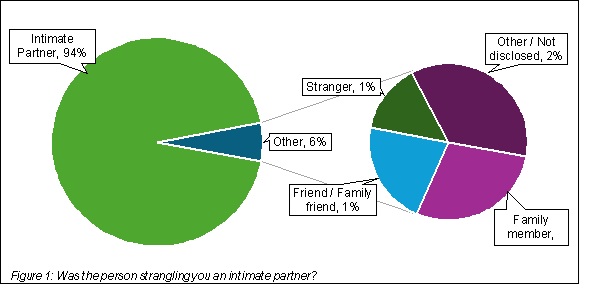
The results of the relationship between the victim and perpetrator of NFS is outlined in Figure 1. 94% (n=441) of respondents indicated that the perpetrator was an intimate and 6% (n=28) said they were not an intimate partner. Only 1% of participants (n=4) indicated their attacker was a stranger, dispelling a common misconception that strangulation would most frequently occur during sexual assault by a stranger.
3. History of Coercive and Controlling Behaviour
Respondents in this survey made frequent reference to this coercive and controlling behaviour when asked what their perpetrator said during the attack(s):
“You will learn to do as I say.” (Respondent 280)
“I shouldn’t question him. That I shouldn’t undermine his authority. That I should always do everything he wanted. Or next time he’d go further.” (Respondent 351)
“Slut, worthless, not worth living, pathetic, no one likes you, no one wants you, you don’t deserve to live, I have to put up with you no-one else would. I want you to die slowly. He would spit in my face at the same time too and I couldn’t wipe it so it would be dripping down my face.” (Respondent 88)
“He wanted my bank card to take control of finances that the government gives me for the children.” (Respondent 240)
“Mostly name calling and telling me that as my husband he had a right to do what he wanted to me. He also threatened to kill me a number times and he threatened to kill our children. I was terrified and I believed he had it in him to kill me and/or our children.” (Respondent 150)
Coercive and controlling behaviour almost always appeared in the accounts if NFS within IPV. Stansfield and Williams (2014) also found a high prevalence of extreme controlling behaviours in their research involving 4,768 male IPV perpetrators in the U.S. Thomas et al. (2014) found it ‘nearly impossible’ for victims in their study to discuss NFS without also talking about coercive and controlling behaviour. Survivors in Thomas et al.’s (2014) study reported compliance with instructions, rules and abusive behaviours out of extreme fear of further attack/s.
4. History of abuse
In cases of fatal and NFS there is frequently a background of other violence including physical, psychological, sexual, and coercive control against the victim and against former partners (Edwards, 2015). Although the data in this study does not provide insight into abusers’ prior relationships, it does suggest it is common for victims to be repeatedly subjected to IPV and NFS assaults:
“He did it many times, I usually passed out” (Respondent 72)
“I fought to get free one occasion, he then beat me horrifically. On other occasions it was more a threat, and he would stop when he seen me really struggling.” (Respondent 35)
“I eventually left. However, this was a regular occurrence.” (Respondent 74)
As a form of coercive control, NFS is so traumatic that, often, it need not be repeated for compliance and submission to be achieved (Thomas et al., 2014). However, the data from this survey records that NFS perpetrators may regularly inflict NFS on their victims. This mirrors Lovatt et al.’s (2022) Australian research which found 93% of survivors had been assaulted more than once and Thomas et al.’s (2014) U.S. study which found 76% of women in domestic abuse shelters found had been strangled multiple times.
5. Perpetrator Displayed Insecurity
When asked what was said by the perpetrator during the assault, responses often featured motivations of insecurity, centred around jealousy, hypersensitivity and being distrustful:
“Don’t laugh at me” (Respondent 234)
“He was angry I had spoken to a man.” (Respondent 12)
“How could I so betray him (I was on the phone with a work colleague)” (Respondent 219)
“He accused me of having an affair because I took too long to do our shopping. He kept saying “I told you I’d kill you if you went with anyone else”” (Respondent 257)
This affirms the personality traits and behavioural patterns outlined in relation to IPV perpetrators above, particularly hypersensitivity (Lancer, 2017), fear of embarrassment and need for reassurance of their masculinity (Aloyce et al. 2023), jealousy and possessiveness (Aloyce et al. 2023; Kyegombe et al. 2022; Lancer, 2017; Rakovec-Felser, 2014; Thomas et al. 2014), requiring constant attention (Kyegombe et al. 2022; Thomas et al. 2014), distrust (Lancer, 2017; Rakovec-Felser, 2014), blaming their behaviour on others (Lancer, 2017) and needing to be in control (Aloyce et al. 2023; Kyegombe et al. 2022; Lancer, 2017).
6. Pleasured by inducing fear
Forensic physician, White (2023), described the act of strangulation as:
“a very intimate crime, often committed face-to-face, eye-to-eye. His hands around her neck (as it is overwhelmingly male against female) the perpetrator and his victim have a shared understanding that her life is literally in his hands. Many victims believe that they are about to die, their fate at the mercy of the attacker.”
Participant’s survey responses suggest a theme of perpetrators deriving enjoyment from the extreme life-threatening fear of death experienced by the victim. For example:
“…I thought I would die that night. The more I struggled the more he laughed. I was 18 years old.” (Respondent 335)
“He was laughing and saying this was revenge for me leaving him” (Respondent 326)
“Sneering and laughing at me because I had tears in my eyes and was gasping for air.” (Respondent 435)
“I would pass out sometimes which he didn’t like as he liked the fear in my eyes” (Respondent 374)
Whilst humiliation, embarrassment and degradation of victims are common in IPV (CPS, 2022b), the accounts add the element of perpetrators gain pleasure from inflicting these behaviours and the intense fear experienced by their victim. Some respondents also disclosed their attacker derived sexual gratification from inflicting NFS:
“He would just snap out of it then have sex with me as I was trying to catch my breath. If I had passed out, I would wake up to him having sex with me.” (Respondent 168)
“It would turn them on to make me pass out” (Respondent 30)
Following campaigns against the so-called ‘rough sex’ defence (Bows and Herring, 2020), the UK Government stipulated this is no longer a defence within the Domestic Abuse Act 2021, aiming to send the message that causing serious or fatal harm in any circumstance is unacceptable and that men can no longer avoid prosecution for injuries or death caused under the premise of being consensual or perceived as enjoyable.
7. Capable of homicide
Finally, analysis highlighted a somewhat unexpected theme of homicidal ideation and capability, including:
- the perpetrator verbally communicating intention to kill their victim
“Your [sic] going to die, I’m going to kill you…” (Respondent 23)
“I’m going to kill you” (Respondent 21)
“…I have started now so I cant [sic] stop, one of us has to die tonight” (Respondent 34)
“Are you ready to die? Any last requests? Last words? I will kill you” (Respondent 156)
“I thought I was going to die. And I’m sure that was his intention” (Respondent 13)
- the victim losing consciousness and, in some cases, requiring resuscitation
“I passed out when I came to he was trying to resuscitate me” (Respondent 25)
“I passed out and came round with him putting damp clothes on my face and shaking me and crying” (Respondent 371)
“He stopped and then started again. Stopped second time after I peed myself and passed out” (Respondent 8)
“Physically it felt like my eyes were going to pop, followed by my head and neck wanting to explode. Tunnel vision comes, buzzing that gets louder and louder until it’s black. unconscious. The gasp of breath when they let go is in sheer panic, confusion, fuzziness, buzzing, temporary deafness, massive headache, blurred tunnel vision, coughing, crying, spluttering, I might have accidentally urinated a little a few times…” (Respondent 239)
“I passed out from strangulation and evacuated my bladder and bowels. The pressure on my neck was intense, I saw stars and then blacked out” (Respondent 9)
- the perpetrator only ceasing strangulation when disrupted, fought off, or victim became unconscious.
“I gurgled my last breath. We both heard it” (Respondent 316)
“I stopped breathing and struggling.” (Respondent 33)
“On one occasion [I was] on a ventilator in hospital as my windpipe was crushed. Unfortunately, he told them that I’d tried to hang myself so by the time I came round I wasn’t believed” (Respondent 7)
NFS, often accompanied by death threats (Edwards and Douglas, 2021), is associated with increased risk of future harm and death (Glass et al., 2008). Although the most common intention of NFS is believed to be instilling fear and control, rather than cause death (SUTDA, 2020), statistics related to death by strangulation demonstrate the significant risk. This is not to say all perpetrators intend, or will, kill their victim, but given NFS can easily be lethal, by strangling their victim perpetrators show intention to cause harm and even death (White et al., 2021). Strangulation to unconsciousness can only have the intention for serious harm or death, as there would be sufficient time for the perpetrator to know what they were doing to their victim from obvious negative responses such as the victim struggling, coughing, gasping and resisting until unconscious (motionless and decreased breathing) and to decide to desist (Edwards, 2015). More than 1 in 6 victims of NFS reported loss of consciousness and urinary incontinence indicates at least seven seconds of unconsciousness and faecal incontinence at least twenty-three seconds suggesting a near-lethal assault (White et al. 2021). Even with no visible injuries at the time, strangulation victims have died in the following weeks and months from the damage caused (Douglas and Fitzgerald, 2022).
Conclusion
This research spotlights perpetrators of NFS in identifying common characteristics of NFS offenders and their behavioural motivators. Exploring patterns in the accounts of the women survivors of NFS highlights its seriousness and potential lethal danger.
Nearly all NFS in the sample occurred with a male perpetrator, the vast majority of whom were a current or former intimate partner, and for many this was not the first time their perpetrator had strangled them. There was a high prevalence of previous and multiple forms of abuse and NFS was often triggered by the perpetrator’s insecure, jealous or embarrassed responses to a lack of control over the victim. NFS can have traumatic impacts, nearly all participants reported experiencing coercive control and NFS was frequently used as a method to maintain control and forcing submission through instilling chronic fear. Most women respondents believed that they were going to die. In some cases, perpetrators displayed homicidal ideation and/or enjoyment of the victim’s response to extreme fear, including laughter or sexual pleasure. Some survivors reported loss of consciousness and bladder and/or bowel control suggesting they were victims of near-lethal assault.
Awareness of the potentially fatal risk of NFS and those who inflict it is required to recognise the dangers, prevent serious harm, protect women and prevent future loss of life. Further research should focus on collecting primary data through questions tailored to address gaps in knowledge about offenders such as age, location, ethnicity, socio-economic data, prior convictions and the trigger/circumstances leading up to the attack(s). Additionally, characteristics identified in this study would benefit from testing against available information on those convicted under the NFS offence since its introduction in June 2022. A reliable offender profile has the potential to positively impact practice, inform appropriate police responses and advise prevention strategies, intervention programmes and victim services.
From the information gathered in this study, it is apparent the lethal danger and extreme trauma of NFS is still not widely understood. Police and medical professionals would benefit from specific education to recognise the signs and symptoms of NFS, especially as it is common for no visible external injury to be present. Better public understanding would also support the breakdown of stigma surrounding IPV and remove barriers to women seeking support.
Finally, the NFS offence was introduced to address gaps in the law which allowed abusers to avoid prosecution. It would be useful to review the success of the NFS offence in increasing conviction rates in comparison to NFS reports prior to its introduction.
References
Allen, R., Elliot, K., Harvey, H., O’Callaghan, C. & Smith, K, I. (2020). Femicide Census 2020. Available at: https://www.femicidecensus.org/wp-content/uploads/2022/02/010998-2020-Femicide-Report_V2.pdf
Bazeley, P. (2018). Integrating Analyses in Mixed Methods Research. London: SAGE Publications Ltd.
Bichard, H., Bryne, C., Saville, C.W.N., & Coetzer, R. (2022). ‘The neuropsychological outcomes of non-fatal strangulation in domestic and sexual violence: A systematic review’, Neuropsychological Rehabilitation, 32(6), pp. 1164-1192.
Boos, J, D. (2019). ‘Non-fatal strangulation: Hidden injuries, hidden risks’, Emergency Medicine Australasia, 31(3), pp. 302-308.
Bows, H. & Herring, J. (2020). ‘Getting Away With Murder? A Review of the ‘Rough Sex Defence’, The Journal of Criminal Law, 84(6), pp. 525-538.
Braun, V. and Clarke, V. (2012) ‘Using thematic analysis in psychology’, Qualitative Research in Psychology, 3(2), pp. 77-101.
Case, S., Johnson, P., Manlow., D., Smith., R. and Williams, K. (2021). The Oxford Textbook on Criminology 2nd Edn. Oxford: Oxford University Press.
Crown Prosecution Service (CPS) (2023). Controlling or Coercive Behaviour in and Intimate or Family Relationship. Available at: https://www.cps.gov.uk/legal-guidance/controlling-or-coercive-behaviour-intimate-or-family-relationship#:~:text=forcing%20the%20victim%20to%20take,%2Finvestments%2Fmortgages%2Fbenefit%20payments
Crown Prosecution Service (CPS). (2022a). Non-fatal strangulation or non-fatal suffocation. Available at: www.cps.gov.uk/legal-guidance/non-fatal-strangulation-or-non-fatal-suffocation
Crown Prosecution Service (CPS). (2022b). Children are often present during non-fatal strangulation, CPS analysis shows. Available at: https://www.cps.gov.uk/cps/news/children-are-often-present-during-non-fatal-strangulation-cps-analysis-shows#:~:text=It%20revealed%20that%20in%2038,the%20offending%20was%20taking%20place.
DeHart, D. & Lynch, S, M. (2013). ‘Gendered pathways to crime: The relationship between victimization and offending’, in Renzetti, C, M., Miller, S, L., and Gover, A, R. (ed.) Routledge International Handbook of Crime and Gender Studies. Abingdon: Routledge, pp. 120-138.
Domestic Abuse Act 2021. Available at: www.legislation.gov.uk/ukpga/2021/17/contents/enacted
Douglas, H. & Fitzgerald, R. (2020). ‘Women’s stories of non-fatal strangulation: Informing the criminal justice response’, Criminology & Criminal Justice, 22(2), pp. 270-286.
Edwards, S, M., & Douglas, H. (2021). ‘The criminalisation of a dangerous form of coercive control: non-fatal strangulation in England and Wales and Australia’, Journal of International and Comparative Law, 8(1), pp. 87-119.
Edwards, S. (2015). ‘The strangulation of female partners’, Criminal Law Review, (12), pp.949-966.
Femicide Census 2020. Available at: www.femicidecensus.org
Glass, N., Laughon, K., Campbell, J., Wolf Chair, A, D., Block, C, R., Hanson, G., Sharps, P, W. and Taliaferro, E. (2008). ‘Non-fatal strangulation is an important risk factor for homicide of women’, The Journal of Emergency Medicine, 35(3), pp. 329-335.
Guest, G., MacQueen, K. M. & Namey, E. E. (2012). Applied Thematic Analysis. London: SAGE Publications Ltd.
Hawley, D, A,, McClane, G, E. & Strack, G, B. (2001). ‘A review of 300 attempted strangulation cases part III: injuries in fatal cases’, Violence: recognition, management, and prevention, 21(3), pp.317-322.
Her Majesty’s Inspectorate of Constabulary (HMIC). (2015). Increasingly everyone’s business: A progress report on the police response to domestic abuse. Published online: HMIC. Available at: www.justiceinspectorates.gov.uk/hmicfrs/publications/increasingly-everyones-business-a-progress-report-on-the-police-response-to-domestic-abuse/
HM Government. (2021). Tackling violence against women and girls strategy. Available at: https://www.gov.uk/government/publications/tackling-violence-against-women-and-girls-strategy
Home Office. (2022a). Strangulation and suffocation. London: Crown Copyright.
Home Office. (2022b). Consent to serious harm for sexual gratification not a defence. Available at: https://www.gov.uk/government/publications/domestic-abuse-bill-2020-factsheets/consent-to-serious-harm-for-sexual-gratification-not-a-defence
Institute for Addressing Strangulation (IFAS). (2023). UK Prevalence of Strangulation & Suffocation. Available at: https://ifas.org.uk/wp-content/uploads/2023/05/IFAS-01-Prevalence.pdf
Johnson M. P. (2008). A typology of domestic violence: Intimate terrorism, violent resistance, and situational couple violence. Boston: Northeastern University Press.
Jordan, K, S., Murphy, J, A., Romine, A, J., & Varela-Gonzalez, L. (2020). ‘A Case of Nonfatal Strangulation Associated with Intimate Partner Violence’, Advanced Emergency Nursing Journal, 42(3), pp. 186-195.
Kelly, R., & Ormerod, D. (2021). Non-Fatal Strangulation and Suffocation. Criminal Law Review, 7, pp. 532-555.
Kibiswa, N, K. (2019) ‘Directed Qualitative Content Analysis (DQICA): A Tool for Conflict Analysis’, The Qualitative Report, 24(8), pp. 2059-2079.
Lancer, D. (2017). ‘The truth about abusers, abuse, and what to do: How to spot an abusive partner before it’s too late’, Psychology Today blog, 6 June, Available at: https://www.psychologytoday.com/gb/blog/toxic-relationships/201706/the-truth-about-abusers-abuse-and-what-do (Accessed 25 July 2023).
Lovatt, H., Lowik, V., & Cheyne, N. (2022). The voices of women impacted by non-fatal strangulation: Summary Report – Key themes. Queensland: CQ University
Mackenzie, F. (2023). ‘The Rough Sex Defence in the UK’, in Bows, H. and Herring, J. (ed.) ‘Rough sex’ and the criminal law. Bingley: Emerald Publishing Limited, pp. 151-166.
McPhee, D., Hester, M., Bates, L., Lilley-Walker, S, J., & Patsios, D. (2022). ‘Criminal justice responses to domestic violence and abuse in England: an analysis of case attrition and inequalities using police data’, Policing and Society, 32(8), pp. 963-980.
Ministry of Justice & Atkins, V. (2022). Press release: New non-fatal strangulation offence comes into force. Available at: www.gov.uk/government/news/new-non-fatal-strangulation-offence-comes-into-force
Monckton-Smith, J. (2020). ‘Intimate Partner Femicide: Using Foucauldian Analysis to Track and Eight Stage Progression to Homicide’, Violence Against Women, 26(11), pp. 1267-1285.
Mshweshwe, L. (2020). ‘Understanding domestic violence: masculinity, culture, traditions’. National library of medicine, 6(10), DOI: 10.1016/j.heliyon.2020.e05334
Office for National Statistics (ONS). (2021) Domestic abuse prevalence and trends, England and Wales: year ending March 2021. Available at: www.ons.gov.uk/peoplepopulationandcommunity/crimeandjustice/articles/domesticabuseprevalenceandtrendsenglandandwales/yearendingmarch2021
Office for National Statistics (ONS). (2021) Nature of sexual assault by rape or penetration, England and Wales: year ending March 2020. Available at: https://www.ons.gov.uk/peoplepopulationandcommunity/crimeandjustice/articles/natureofsexualassaultbyrapeorpenetrationenglandandwales/yearendingmarch2020#:~:text=This%20was%20closely%20followed%20by,43%25)%20(Figure%202).
Pritchard, A.J., Reckdenwald, A. & Nordham, C. (2017). ‘Nonfatal Strangulation as Part of Domestic Violence: A Review of Research’, Trauma, Violence and Abuse, 18(4), pp. 407-424.
Rakovec-Felser, Z. (2014). ‘Domestic Violence and Abuse in Intimate Relationship from Public Health Perspective’, Health Psychology Research, 2(3), Available at: www.ncbi.nlm.nih.gov/pmc/articles/PMC4768593/
SafeLives (2015). Insights Idva National Dataset 2013-14. Bristol: SafeLives. Available at: https://safelives.org.uk/sites/default/files/resources/Insights%20Idva%20national%20dataset%202013-2014.pdf
Safe Shelter, (2022). Why Domestic Violence Affects Women at Higher Rates Than Men. Available at: https://safeshelterofstvrain.org/2022/03/07/why-domestic-violence-affects-women-at-higher-rates-than-men/#:~:text=It%27s%20not%20because%20women%20are,help%20or%20making%20a%20change.
Sheehy, E., Grant, I., & Gotell, L. (2023). ‘Resurrecting ‘She Asked for It’: The Rough Sex Defence in Canadian Courts’, Alberta Law Review, 60(3), pp. 651-686.
Stansfield, R. & Williams, K, R. (2021). ‘Coercive Control Between Intimate Partners: An Application to Nonfatal Strangulation’, Journal of Interpersonal Violence, 36(9), pp. 5105-5124.
Thomas, K, A., Joshi, M., & Sorenson, S, B. (2014). ‘“Do you know what it feels like to drown?”: Strangulation as coercive control in intimate relationships’, Psychology of Women Quarterly, 38(1), pp. 124-137.
Walby, S., & Allen, J. (2004). Domestic violence, sexual assault and stalking: Findings from the British Crime Survey. London: Home Office.
Weisberg, D, K. (2022). Domestic Violence: Legal and Social Reality. United States: Aspen Publishing.
White, C. (2023). Why we needed a new Non Fatal Strangulation Offence, explains a forensic physician. Available at: https://domesticabusecommissioner.uk/blogs/why-we-need-a-new-non-fatal-strangulation-offence-explains-a-forensic-physician/
White, C., Martin, G., Schofield, A, M., Majeed-Ariss, R. (2021). ‘‘I thought he was going to kill me’: Analysis of 204 case files of adults reporting a non-fatal strangulation as part of a sexual assault over a 3-year period’, Journal of Forensic and Legal Medicine, 79, pp. 1-10.
Wincup, E. (2017). Criminological Research: Understanding Qualitative Methods. 2nd edn. London: SAGE Publications Ltd.
Women’s Aid. (2022). Domestic abuse is a gendered crime. Available at: https://www.womensaid.org.uk/information-support/what-is-domestic-abuse/domestic-abuse-is-a-gendered-crime/