
| Chaplaincy
the bread of life
Jesus, the bread of life
When they found him on the other side of the lake, the disciples asked Jesus, “Rabbi, when did you get here?”
Jesus answered, “Very truly I tell you, you are looking for me, not because you saw the signs I performed but because you ate the loaves and had your fill. Do not work for food that spoils, but for food that endures to eternal life, which the Son of Man will give you. For on him God the Father has placed his seal of approval.”
Then they asked him, “What must we do to do the works God requires?”
Jesus answered, “The work of God is this: to believe in the one he has sent.”
So they asked him, “What sign then will you give that we may see it and believe you?What will you do? Our ancestors ate the manna in the wilderness; as it is written: ‘He gave them bread from heaven to eat.”
Jesus said to them, “Very truly I tell you, it is not Moses who has given you the bread from heaven, but it is my Father who gives you the true bread from heaven. For the bread of God is the bread that comes down from heaven and gives life to the world.”
“Sir,” they said, “always give us this bread.”
Then Jesus declared, ‘I am the bread of life. Whoever comes to me will never go hungry, and whoever believes in me will never be thirsty’.
In the reading from John’s Gospel, Jesus makes a distinction between the bread that fed his ancestors and the bread from God which ‘gives life to the world’.
We might wonder a little more about this bread.
What is this bread that gives LIFE?
The bread that the people then ask to receive?
The bread that Jesus refers to as his very self?
Julian of Norwich, whose writings are the earliest existing texts from the pen of an English woman, dating back to the 14th Century, speaks rather more simply about this gift from God of God’s self.
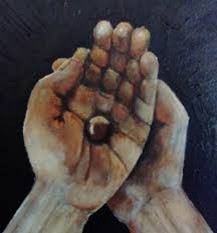
In her book, Revelations of Divine Love, she describes a vision that she has of a hazelnut. We in the 21st Century have to remember that a hazelnut to a woman such as Julian was the most ordinary thing of little importance. Julian would have walked through woodlands where hazelnuts were strewn across the forest floor, she would have eaten them raw, cooked them, crushed them to preserve as food for the winter. The hazelnut would have been used as a way of gaging the size or quantity for ingredients in cooking, the shell would have been used to scatter salt and then discarded. The hazelnut was so utterly commonplace and entirely ordinary that when this little ‘thing’ appeared in her vision as a solitary thing in the palm of her hand, she would have been confused.
In her vision, she reports, asking God,
‘What is it?’
Julian hears a response, not exactly the voice of God but a voice from within her understanding but still different to what she was thinking,
‘It is all that exists’
She marvels at how such a small thing can exist without being blown away or forgotten. What is it, she wonders, that keeps this small, inconsequential thing from disappearing into nothing. Again, she receives an answer not specifically from God’s mouth but in a general way, through an illumination given directly to her mind. The response was short, direct, precise:
‘It exists because God loves it’
And in that same moment she understands that it, this tiny inconsequential hazelnut, exists or ‘has its being’ in the same way that all things exist, solely because of the love of God.
The humble hazelnut becomes for Julian a symbol of all of creation enclosed in a tiny round ball. The fact that it is small does not mean it is less loved, it is valued equally with the sun, moon and stars, all the wonders of creation and the uniqueness of human being.
In that moment, she understood that creation is nothing but the expression of Divine Love. She looks and sees that the hazelnut has three properties. Not its hardiness, usefulness, and tastiness. Rather,
“the first is that God made it,
the second is that God loves it,
the third is that God protects it.”
Julian is echoing the thought of St. Augustine here:
“Thou hast made us for thyself, O Lord, and our hearts are restless until they rest in thee.”
And this is the point we hear Jesus making in the Bible reading. We are so often fixed on our earthly needs, the bread of life, that we become out of touch with our soul. We are distracted by our own ultimate destiny that we forget the good in the everyday. We think we are striving after what will make us happy until we either get it and realize it cannot satisfy our fundamental longing, or we lose it and start craving something else.
So, the simple hazelnut reminds Julian that she is an expression of God’s creation and that is enough. Just as Jesus refers to himself as the bread of life, the expression of love for humanity, the evidence for God’s desire to nourish, sustain and protect us.
And so, as we draw closer to Christmas, to the time of excess, the time when we long for a richer, deeper experience of love and life, find something small and simple, a hazelnut or a piece of bread and ponder the possibility that God made it, that God loves it, that God protects it.
Now put yourself in the place of the hazelnut and know that you too are a part of God’s creation, a part that God sustains, a part of something in which we can find rest, secure in the knowledge that we are already enough.