
| Chaplaincy
called to be peacemakers
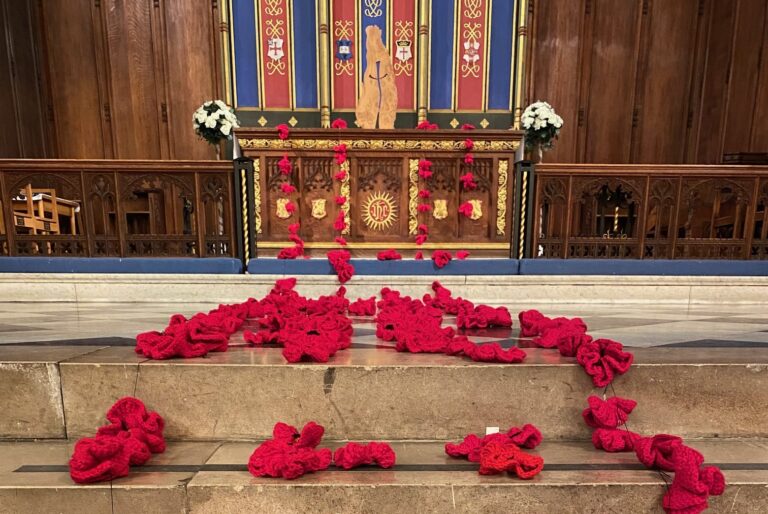
On Tuesday at our Gathering for Remembrance we used some crocheted poppies to make a river of remembrance. We were thinking about all those who have died or suffered across the world because of war – in this country, and around the world. Each of us imagined a person who lost their life – first one of the students who died in the First and Second World Wars. And then we imagined one of the people who have lost their life just in the last year, in places like Ukraine, Gaza, Sudan and Syria. Then we added these poppies to the river.
It was moving to see the poppies placed as we listened to the music. It’s important to stop and remember, but it can lead to a sense of hopelessness. When will the fighting ever stop? How can we make any difference? It can lead to us feeling inadequate, and overwhelmed, and us feeling guilty.
When I was young I used to feel that it was my responsibility to change the world. But we are not responsible for changing the whole world. We have to leave that to God. I think our role is to listen to the particular calling that God has for us, which will be different for each of us. When it comes to peacemaking, I said on Tuesday that this might be – to campaign for justice, to build relationships, to overcome hatred and division close to home, to support in some way those devastated by war. Being freed from responsibility for everything may help us be more able to focus on listening to God, seeing what we are drawn to, feeling the Spirit move in our spirit, and responding to whatever our particular call is.
Oscar Romero, the Archbishop of San Salvador, was a great fighter for justice, but he said this about our individual callings:
It helps, now and then, to step back and take the long view. The kingdom is not only beyond our efforts, it is beyond our vision.
We accomplish in our lifetime only a tiny fraction of the magnificent enterprise that is God’s work. Nothing we do is complete, which is another way of saying that the kingdom always lies beyond us.
This is what we are about: We plant seeds that one day will grow. We water seeds already planted, knowing that they hold future promise. We lay foundations that will need further development.
We cannot do everything and there is a sense of liberation in realising that. This enables us to do something, and to do it very well. It may be incomplete, but it is a beginning, a step along the way, an opportunity for God’s grace to enter and do the rest. We may never see the end results, but that is the difference between the master builder and the worker. We are workers, not master builders, ministers, not messiahs. We are prophets of a future not our own.
In the last part of our gathering I asked people to hold a white peace flower, and to be open to the calling that God has for each of us. Imagine instead of a red river of sadness, a sea of white if we all, in our own way, enabled the flower of peace to bloom.
So let's bring this reflection to God in our prayers.
Firstly, we focus the poppy. We remember what this represents - the tragic brokenness of the world. This is God’s world, and we believe that God loves the world, so we may sense how deeply God feels this brokenness. We share in that love, and in that sadness.

Now we focus on the peace flower. God longs to change the world through those who open their hearts to the spirit of love and peace. We cannot solve the world’s problems. Can we sense something of God’s call to us…? Maybe we are already responding to that call. Maybe we sense a new invitation opening up. Maybe we are still unsure, still listening…

God of love, you long for peace and healing for this world.
May we share your longing, without despair.
May we offer ourselves to your purposes without being overwhelmed.
May we trust in your Spirit to guide us in each next step.
Give us the wisdom, the grace and the courage that we need.
And may we see your love bringing small but real differences in your world, through us.